Posts

Love and Marriage

Image
It’s that time of year when thoughts turn to love and romance. The shops (those that are open) are full of hearts and cards professing true love and there are the usual ‘romantic’ gifts available – yes it’s Valentine’s Day. Marriages are one of those key vital pieces of the family history jigsaw and help the family historian to expand the branches of their ever growing family tree. It is hoped that our ancestors all married for love and that every wedding was a happy and joyous event shared by family and friends alike but this was not always the case. My Grandparents' Wedding 1935 Looking back over the registers and certificates a pattern begins to emerge as to when and why couples got married. A number of mine and my wife’s ancestors married at Easter or at Christmas, either on Christmas Day or Boxing Day. When you look at the records you start to see that they were either in service or in occupations which meant that they got very little time off so had to take advantage when the...

52 ancestors in 52 weeks

I have been a little bit lazy about my blog over the last few weeks – I blame Christmas – but I thought to give myself some impetus to blog more regularly I would attempt to meet the challenge set by Amy Johnson Crow to write something every week based on her themes set in 52 Ancestors in 52 weeks. Week 1’s theme is Beginnings. I previously wrote in my opening blog ‘How Did This All Begin?’ about my reasons for starting to research my family history so I thought I would talk about how I would advise someone else to get started.  A question I have been asked by friends and colleagues regarding researching family history is where do I start? The advice I was given early on was to start with yourself. Write down everything you know about yourself, your parents, grandparents, aunts and uncles, siblings etc. The first thing I did was to try and flesh out a basic family tree of my immediate family and build from there. The second thing to do is ask! Talk to family members and try and fil...

Two sad deaths

Image
  The third person in my series on Remembrance is Lance Corporal George Anderson. George was my wife’s first cousin twice removed and was born in Sheffield in 1889.   George was a labourer, married with two children when war broke out in August 1914. The family lived in the Shalesmoor area of Sheffield, just off Penistone Road.   George enlisted in the 7 th Battalion, East Yorkshire Regiment on 11 th September 1914, barely a month after war was declared. He was part of a wave of enthusiastic enlistment by thousands of men at a time when everyone was saying the war would be over by Christmas.   According to his service record, George was based in England up to 12 th July 1915, when the battalion was sent overseas and took up positions in the Ypres Salient. The battalion was part of 50 th Brigade, 17 th Northern Division.   George must have been a good soldier and was promoted to Lance Corporal, in the field, on 18 th February 1916.   ...

Mother and her boys

Image
  At 11 am on the 11 th Day of the 11 th month the guns fell silent and the fighting was over. The war to end all wars, The Great War, was over. Every year, people gather at war memorials, grave sites, battlefields, in churches and places of worship to fall silent for 2 minutes to remember all those killed in all conflicts.   Probably every family historian will have a family member who served, fought or died in the First World War, certainly in the UK. Cities, towns and villages lost a generation on the blood soaked battlefields of the Western Front but also across the world in what was the first truly global war, fought on an industrial scale with all the new technology of a industrial world.   Over the next few weeks I am going to try and tell the stories of just a few of these brave men who fought and died for their country.   I start with the story of two brothers, born into a colonial, middle class Victorian family who died within 17 days of each other ...

What's In A Name??

  Be it your own name or that of your parents or grandparents, every story starts with a single name.   A well-known commercial family history website advertises that all you need to do is enter a name in the search box and all this information will come tumbling out. If only it was that simple! It doesn’t take long to discover that families had naming traditions. The most obvious one is that the first born son would be named after the father and the first born daughter would be named after the mother. You soon find long lines of male ancestors sharing the same name. In my own family William Armstrong is a name that goes back into the 18 th century. My wife’s family has a line of Thomas Anderson going back to the 1820s and a line of Robert Ramseys going back to 1789. You find the same names repeat themselves in families so the siblings of each generation often share names so you will have long lists of James, David, Sarah or Susan. A lot has been written about Scottis...

Johnnie Armstrong and the day we nearly bought a tower!

Image
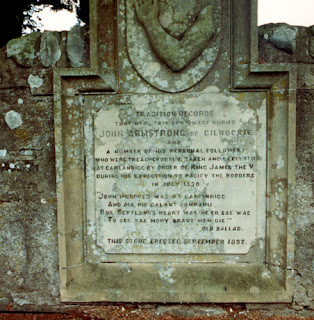
  Johnnie Armstrong and the day we nearly bought a tower!   We won’t be the first family of Armstrongs to try and find a genealogical link to the notorious Border Reiver, Johnnie Armstrong, and I’m pretty sure we won’t be the last but back in 1990 we nearly bought one of his towers!   Johnnie Armstrong of Gilnockie was a famous Scottish Border Reiver, or raider, in the early 16 th century who was eventually captured and hanged by King James V at Caerlanrig along with 36 of his men. There are a number of legends associated with Johnnie including one that he inspired the term ‘blackmail’ due to his black chainmail which he wore. Johnnie would capture livestock and people from the English and then ransom them back.   Memorial at Caerlanrig Chapel There is a romanticised version of Johnnie Armstrong promoted by the writings of the like of Sir Walter Scott and Herbert Maxwell and he is immortalised in the ‘Ballad of Johnnie Armstrong.’ In reality Johnnie was ...

The Rev Robert Cunningham

Image
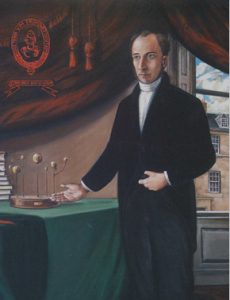
  The Reverend Robert Cunningham.   My first post explained what, or indeed who, had started me on my family history journey so I thought it was only fair that this week I tell you all a bit about the man himself.   Robert Cunningham was born on 17 th August 1799 in Stranraer in the South West of Scotland, son of Andrew Cunningham and Janet McBryde. His father was a merchant trading in and around the Irish Sea.   Although he studied for the ministry at Edinburgh University, Robert was first and foremost a schoolmaster. His father died around 1819 and he had to take up employment as headmaster of Saltoun Parish School to support his widowed mother and younger siblings. He continued to teach in and around the East of Scotland and in 1826 took up the post of House Governer at George Watson’s College, Edinburgh.   In 1832 he became the founding headmaster of the Edinburgh Institution and on 28th October 1832 married Elizabeth Jeffrey, the daughter o...